Vitus CL 1 specification

Frame and fork: Vitus CL 1, 19 inch centre - top.

Head set: Stronglight A9, 1", threaded

Cranks: Shimano Deore LX, 170 mm, 48-38-28 T.

Bottom Bracket set: Shimano Deore XT, BSC thread, 68 mm BB shell, 122.5 mm axle length

Rear derailleur: Shimano Deore LX

Front derailleur: Shimano Deore LX

Brake / Shifting levers: Shimano Deore LX, STI 3x7

Brakes: Shimano Deore LX cantilever, low profile

Hubs: Shimano Deore LX, 32 holes

Rims: Araya, 32 H (update 2020: changed to Rigida DP22)

Tyres: Tioga Psycho Tioga Psycho K (front), Tioga Psycho TT (rear) (update 2020: changed to Panaracer Dart/Smoke 26x2.1)

Sprockets: Shimano CS-xxxx  12-30 T, 7-speed

Chain: KMC Z82

Pedals: Shimano PD-M737

Saddle: Selle San Marco Rolls

Seat Post: Sakae Ringyo Laprade, 27.2 mm

Stem: Tioga, xxx cm

Handlebars: xxx cm outside - outside

Grips: Ritchey

This bike on Velospace

Vitus CL 1 ready to ride

The Vitus CL 1 mountainbike is still not completely as I wanted, but it's ready to ride.
There a ride tomorrow, so I have to deal with it.
Full Deore LX and mainly period correct components.
It weighs a ton, but I don't give a shit. I guess that the weight was pretty normal for the early 1990s and that meanwhile we got used to featherweight MTBs.

Tioga Psycho tyres

New rubber for the Vitus CL 1 or Alan Record Carbonio MTB.
Tioga Psycho TT for rear, Psycho K for front.

Vitus CL 1 mountainbike

And the second MTB project!
Despite the rough and dull aluminium frame parts, the condition is better that the Alan Carbonio.
This will be a wonderful build. I've found a nice donor bike in good condition: a Giant Escaper with a full Shimano Deore LX group set.

There's a lot of polishing to be done, both parts and frame kit. Everything has to be clean, but I'm not going to "Ray Dobbins" this stuff. All parts should stay original and also this bike should be able to go into the woods and into the dirt. I don't have showroom bikes.

Note: the black piece in the seat stay is just a cover. There's no suspension.

Data:
Seat Tube 47 cm center to center = 49 cm center to top (19")
Virtual top tube length approx. 55 cm.
Seat tube diameter 31.8 mm (FD clamp size)
Seat Post size approx. 27.2 mm
Head Set 1" threaded
Cable routing below top tube and below down tube / BB shell (running through a rail in bottom of top- and down tube, down tube covered with a plastic cap)
BB shell 1.37x24tpi threading (british), width 68 mm.
130 mm OLD
Cantilever brakes only (rear for regular rim brake or optional U-Brake below chain stays)
For 26"wheels.

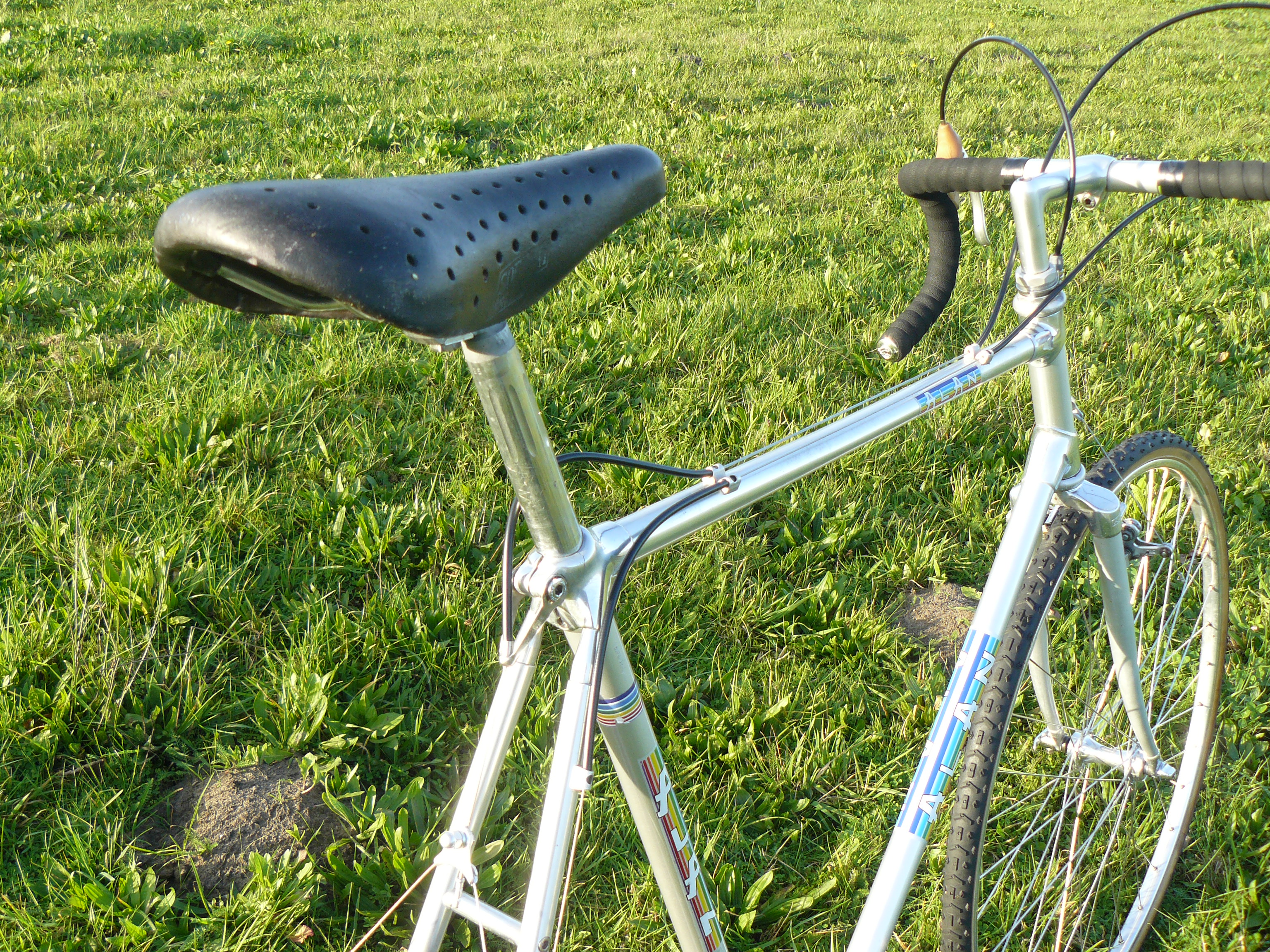
Alan Record Carbonio MTB

Am I getting insane? Starting with a track bike project and ending with an MTB? Yes, it's a strange world. But I like bikes of all kinds.
I've always had something special with Alan bikes, although I never owned one. Untill I started collecting and building up retro bikes and my 1st classic track bike was an Alan.
In the meantime I've built track bikes, cyclocross bikes, road bikes and this time it's going to be an (why not?) MTB.
I had the opportunity to buy a rare carbon Alan MTB, mainly equipped with Deore XT parts. Unfortunately it had the unavoidable crack in one of the head lugs (only a little one), but also a hole in the right hand chain stay. I was a bit upset, but it made the seller lowering the price. After all, it's still a nice Alan with  nearly complete group set, so no bad deal at all.

Now I've stripped the bike and ordered new stickers for the restauration. This winter I will try to clean everything, repair the hole and slowly build up the bike.
It's gonna be awesome.

Data:
43x45
Seat Tube 43 cm center to center = 45 cm center to top (nearly 18")
Top Tube 45 cm, virtual top tube length approx. 56 cm.
Seat tube diameter approx. 33.3 mm (FD clamp size)
Seat Post size approx. 30.0 mm
Head Set 1-1/8" threaded
Handlebar stem 25.4 mm quill
Cable routing below BB shell
Italian BB threading
Cantilever brakes only
For 26"wheels.

Alan Super Cross ready


Frame and fork: Alan Super Cross, March 1984, H: 57 cm centre - top, L: 57 cm centre - centre

Head set: O.M.A.S.

Cranks: Sugino Mighty, home made chain guides, 171 mm.

Bottom Bracket set: Shimano BB-UNxx, Italian thread

Rear derailleur: Campagnolo Nuovo Record

Shifting lever: Sun Tour Power Ratchet bar end shifter

Brakes: Modolo Cross cantilever

Hubs: Mavic 500, 36 H, for scew-on freewheel

Rims: Wolber Super Champion Arc-en-ciel, 36 H

Tubulars: Wolber Wolber Cross 28 Extra

Sprockets: Shimano MF-xxxx  14-28 T

Chain: SRAM PC870

Pedals: Lyotard 460D

Toe clips: Christophe double, size L

Toe straps: Christophe

Saddle: Arius (Soffatti) Professionale perforated

Seat Post: Campagnolo Super Record, 25.0 mm

Stem: Cinelli 1A

Handlebars: Cinelli 66-44

Brake levers: Modolo Superprestige

Bar tape: Black

Spare wheels:
Hubs: Shimano 600 (HB-6207, FH-6207, converted with 7 speed HG freewheelbody)
Rims: Wolber Super Champion Gentleman (front: 81; rear: GTA), 36 H
Tyres: Challenge Grifo Open 32 mm (clincher)
Sprockets: Shimano 13 - 15 - 17 - 19 - 21 - 24 - 28 T.

Eddy Merckx Podio shoes

Eddy Merckx Podio road racing shoes, size 44, to be matched with Podio pedals.
These shoes have a unique hole pattern for the cleats and the correct cleats are already attached.

Due to the special sole design, it shoeld be easier to walk on these shoes in comparison with other cleated road racing shoes.
Usually I wear shoe size #43 and this is #44. These are a bit too large, but I was told that the shoes are very narrow, so I think I can ride them.

Time Equipe Pro Magnésium pedals

Another pair of Time TBT pedals. This is the edition for the Banesto pro team.
Time Equipe Pro Magnesium features a magnesium pedal body and a steel axle.
This ultimate road racing pedal was introduced in 1994 and was used by many Tour de France winners (Indurain, Riis, Ullrich, Pantani). Okay, maybe the lighter version with titanium axles...
The distance between pedal axle and foot was reduced, improving pedalling bio dynamics.
The distance pedal axle to shoe sole (Bioposition) is 8.5 mm.

See Time Sprint for more information about Time road pedals.

Diadora Power Drive SA 210 pedals

Diadora Power Drive pedals and cleats, introduced in 1992.
Cleats are "static", meaning fixed, without float.
The other type is "dynamic".
Failed more or less, because these pedals/cleats could only be combined with proprietary Diadora Power Drive shoes. Next to that, Johan Museeuw struggled with this combination through the 1994 edition of Paris - Roubaix, where he lost the race to a stronger and more clever Andrei Tchmil. Besides that, he had problems with his full suspension Bianchi bike and Diadora cleats jammed in his pedals.

Eddy Merckx Podio pedals

A second attempt of Merckx and the pedal inventor Lilian Christol to come up with a new pedal and cleat system. Maybe this 1994 design worked (I haven't tried it yet, but I've read that it works), but in the beginning, the bolt pattern of the cleats was different from all others in the market. A well know reason to fail in the market.
The pedal design and engagement system differs from Adidas Systeme 3, it looks more like Campagnolo's SGR, with the sides of the cleats sliding into the side rails of the pedals.

The nice thing about my pedals is, that I have a set of cleats, that can be attached to shoes with a Look/Shimano hole pattern.

Next job: try to find a pair of Merckx Podio shoes size 43 and matching cleats.